
Daniel Wentz, Ed.D/MLS
Research Profile and Annotated CV

Welcome
Overview
The purpose of this site is to acquaint visitors with the process of inherent skill development.
The research citations seen below provide a blueprint for identifying your unique ideal vocational goal orientation,
with each link providing novel commentary regarding workflow compatibility most akin to the various skillset profiles.
If interested in collaborating or leasing research, please reach out via LinkedIn, ResearchGate,
or the contact box at the bottom of this page.
Other Profiles
Publications
(links are bolded and underlined)
The 'Using' Series:
Research themes: Creativity, Personality,
Professional development
[ISBN 978-3-8440-9180-9; publisher, Shaker Verlag]
This mixed-method study featured a series of references along with select original research to help the reader examine how they may increase creativity output. 'Creativity' was defined formulaically as a personality attribute impacting problem-solving processes that users should internalize for assessing their compatibility with current or prospective career task orientation. "Creativity is the impulsive cognitive synthesis of various stimuli per spontaneous concentration of interpretive memory recollection, skillful capability, and current needs."
The purpose of this research was to help readers evaluate their professional task orientation for personal skill cultivation. Are they currently in the vocational setting most conducive to their success, intellectual growth, and long-term influence?
The hypothesis stated that each individual possesses a cognitive profile amenable to a combination of daily responsibilities with consideration for broader technical scope. Research culminated with numerical analysis for the following succession of variables as defined regarding creativity, which users can apply to quantitatively compare and assess their own vocational conditions/outlook ..
"Solutions to Problems = (Needs Assessment / Flexibility)
* Adaptability"
The formula may be situationally quantified under contextual pretense. For example, assuming your job is a 'copy editor' ..
"Better writing = (your desire to be more personal / the formality required of your vocation) * your skill-level in technical writing"
This could be hypothetically quantified (scaled 1-3 in ascending order of significance, with either the dividend or divisor being the dependent variable, '1') ..
"Better writing = (3 / 1) * 2 = likelihood for success"
That formula implies a strong predilection for informality ('3'), a low requirement for impersonal writing ('1'), and an average ability for incorporating creativity within your technical writing ('2'). The key to this formula is being able to neutralize the impact of whichever dependent variable is your weakest attribute and finding the combination of skills that will mitigate its impact, while strengthening your job prospects.
If the user desires to be more creative from an informal perspective regarding their writing style, then they could evaluate other editorial job prospects via this formula, substituting any new required criteria, and thus revising said quotient ('likelihood for success').
The research question guided conceptualization of subconscious indicators for identifying viable stimuli, plus how users may subsequently train ideative proclivities.
(2024) Using Needs Assessment to Control Task Orientation
Research themes:
Communication habits, Creativity,
Professional development
[DOI 10.13140/RG.2.2.28745.15202; publisher, ResearchGate]
This research featured explorative narrative regarding job duration within common industries. One 5-question survey was issued to 96 employed users that facilitated a standard x-y axis polarity model of the following relationships ..
Convergent (CI)-Divergent (DI) creative problem-solving tendency;
Interpersonal (IR)-Intrapersonal (IA) collaboration preference
The survey represented attributes defined by cited literature as being most germane to each aforementioned profile's professional growth narrative, thus, relating communication preferences, ideal supervisor relationship per user, and individual technical goals. Connections between task-related industry data were juxtaposed from the survey results using Pearson's R (correlation) for professional autonomy, and applicability (goal orientation alignment between the individual and their institution) of job scope [independent variables], with job tenure duration [dependent variable]. Scores were converted to percentages.
If the subject were a divergent ideator (i.e., adept at devising solutions) that also possessed advanced communication/interpersonal skills, their need assessment is practical growth toward personal career goals. This relationship would be heightened through an intrapersonal bias (or preference for self-sufficient application) in which autonomy is correlated with longer vocational tenure. Professional contentedness increased with the presence of either independent variable. However, the goals of convergent ideators, whose priority is conceptual refinement, were influenced by their institution's objectives.
Readers can analyze how the personality profiles were plotted in relation to the various vocations within said polarity. After assessing their own preferences, this model will allow readers to gauge likelihood for personal development per each featured industry. The following task assumptions were compartmentalized based on personality needs ..
DI-IA profile. Users prefer positions that prioritize ideas or presentations over statistical results; those with technical specialty are particularly conducive to long-term goals.
Career orientation: Finance (strong),
Technology (strong), Education, Legal,
and Public services
DI-IR profile. Users prefer positions in which they can augment skills germane to a personal goal orientation via small-team collaborations with defined autonomous tasks.
Career orientation:
Public services
CI-IA profile. Users prefer narrower scope related to interactions with constituencies, sans work colleagues, and projects that entail implementation in contrast of devising solutions.
Career orientation:
Healthcare (strong),
and Legal
*The CI-IA profile equated to prioritization for autonomy dictated by strategic tasks, rather than communicative roles.
CI-IR profile. Users prefer a level of clout in relation to colleagues, including diverse task scope extending their control, while featuring sequential institutional objectives that will influence personal goals after their initial objectives are met.
Career orientation:
Business, including
leadership (strong),
Manufacturing (strong),
Sales, and Travel
*Supervisors and executives most often fit into the CI-IR profile.
**The interpersonal component was more dependent on the applicability of job scope, which indicated that those with this communication preference generally are happier at work.
Other Publications
- doctoral dissertation
Research themes:
Business skills, Education outcomes,
Professional development
[ISBN 979-8-8193-0882-0;
publisher, ProQuest (document #2672267166)]
The purpose of this qualitative study was to identify which pedagogical tactics facilitated technical and professional administrative office skill development among graduates from Ontario, Canada's 'Bachelor of Business Administration' (B.B.A.) curriculum.
The research question that guided this study was representative of a goal orientation for pedagogical professionals to gauge how much practical application indicated increased learning output. An original interview assessment was devised for measuring said output by sampling ten informants (five employed and five unemployed) regarding how to complete basic office tasks. Scores were aggregated across five core attributes using 18 complementary skills to cross-compare these samples based on employment status.
There were seven skills in which unemployed informants significantly trailed their counterparts. They represented propensities for understanding how data strands are linked across a network. As a desired job recruitment specialty, B.B.A. students should be able to infer cogent conclusions from data presented in diverse formats.
Using this benchmark, the skills identified, all pertaining to Microsoft 'Excel' (spreadsheets/workbooks) and/or 'Access' (databases), included:
-Ability to create formulas for advanced calculations
-Experience with automation tools (e.g., macros)
-Competency with encoding (e.g., XML data)
-Capacity to link data across multiple workbooks [Excel only]
-Aptitude for producing cogent visualizations of data (e.g., charts)
-Capability for establishing relationships within a database [Access only]
-Being able to perform functions across multiple fields within a database table (compatibility of data) [Access only]
The literature review was used to relate each skill to a technical task thus untenable for the aggregate B.B.A. graduate. Production of Macros, processing of XML data, and the ability to write 3D formulas were the three direct tasks found most lacking when compared to employee surveys. The study subsequently culminated with a lesson plan for future instructional designers to address each missing skill.
(2025) The Inferential Language Method: English to Basic Frisian
- feature-length instructional video (writer/video producer)
Research themes:
Language education, Learning by association, Linguistic hierarchy
[distributor, DMY Production]
Hierarchical learning is a methodology in which information is accumulated or ‘stacked’ within preexisting threads of the user’s cognition. The Inferential Language Method was developed to augment the user’s inherent anticipatory prowess regarding foreign grammatical syntax and phonology. This acumen is rationalized as auxiliary to their native language based on the structural similarities. Each subsequent level or ‘tier’ of the hierarchy represents another lexical step. Vocabulary within three steps of native semblance should be considered basic grammar. An analysis for these levels is conducive to mnemonic interpretation of which base ideology is bilateral.
Level 1. This will include near cognates, in terms of language, or other concepts of definable parameters based on the user’s current knowledgebase. For example, ‘foot’ in English = ‘foet’ in the Western Frisian language of Northwest Netherlands. The phonetic vowel structure in the Frisian equivalent will be used to infer related translations.
Level 2. This will include the building blocks necessary to compose your base level of inference. We looked at the translation for ‘oo’ from English to Frisian. What if a word features the long-’o’ sound? The Frisian translation for ‘snow’ equals ‘snie’. We see the familiar ‘e’ and add the ‘i’ for the Frisian phonetic differentiation between the short and long ‘o’ pronunciations.
Level 3. We introduce a vowel gradient for defining these relationships.
O-E-(U)I-E-A-U [Frisian] = e-a(i)-o-y-u(e) [English]
Thereby, ‘blue’ = ‘blau’ in Frisian.
Consider the ‘Six Degrees of Separation Principle’. Utilize the hierarchy format for oscillating between the levels while maintaining contextual integrity. When formulating how to communicate the duration of your work week in Frisian, we begin with our vowel translations, before gravitating toward the anticipatory responses.
“My work week is six days or fifty hours, not including holidays.”
L1. work = wurk; not = net; I = ik
L2. six-day = seis (‘x’ is not used in Frisian) dei; or = of; on (instead of 'including') = op
L3. fifty = fyftich (‘fyft’-’ich’ ..
this suffix recurs for all values in the tens-place starting at ‘20’)
L4. hours = [H]oeren (‘oer’-‘en’ ..
this is a common plural suffix; earlier levels will document silent 'h' use)
L5. holiday = feestdei (‘feest’ [‘feast’ in English] - ‘dei’);
weeks = wiken
L6. “Ik wurk seis-dei wiken of fyftich oeren, net op feestdei wiken.” ..
“I work six-day weeks or fifty hours, not on holiday weeks.”
The ‘Inferential Language Method’ is self-paced and intended to pivot off of practically implied constructs. This tutorial concludes with a self-biography exercise that incorporates eleven phonetic and compositional rules/trends. Users should be able to complete at least nine basic sentences about their interests, which is ideal for travelers to the Friesland province.
(2017) For Your Craft
- debut music album
[label, Overnight-Music; credited as DMY Wentz]
"Fantastic, unique soundscapes" (YouTube commenter)
(2026) WNYO 2008-'09 Interviews
-radio host reel
[promoter, WNYO 88.9 FM]
A collection of exposés with prominent rock musicians during this time period. Featured artists included Yngwie Malmsteen, Björn Gelotte (In Flames), Buz McGrath (Unearth), Chris Barnes (Cannibal Corpse/Six Feet Under), and Andrei Soulsilens.
Affiliations
Instructor History:
-
Business Applications Workshop Instructor at the College of the Florida Keys (2024)
This workshop presented introductory and intermediate components of Microsoft Office applications germane to modern business administration, including modules on database relationships & queries (Access); as well as Power BI & VBA, workbook functions/formulas, pivot tables, mail merges, and graphical visualizations (Excel).
-
College Preparedness Workshop Instructor at Buffalo State College (2016-2017)
This seminar, targeted at incoming freshmen, analyzed the four main citation protocols (APA, Chicago/ Turabian, CSE, and MLA) employed in various industry and academia.
-
Tobacco Awareness Workshop Co-Instructor at Buffalo State College (2016-2017)
Memberships:
-
New York State Department of Education
Certified Public Librarian
Oct 2012 - Oct 2017
-
Association of Professional Researchers for Advancement (APRA)
2016 - 2017
-
NASIG (formerly, the North American Serials Interest Group, Inc.)
2016 - 2017
-
Journal of Library Innovation
Peer Reviewer
Jun 2013 - Dec 2014
Career History
Project Controller at Stantec
April 2026 - current
Program Analyst at MacDonald-Bedford LLC
January 2019 - March 2026
--
Assistant Director of Development and Alumni Engagement at Hilbert College
2018
Data Research Analyst at Buffalo State College
2015 - 2018
Reference Librarian at Niagara University
2013 - 2015
Education
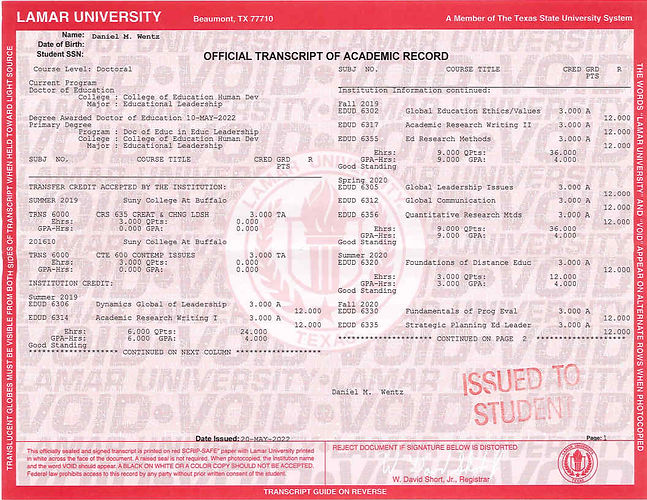
Ed.D., Lamar University
May 2019 - May 2022
Major: Educational Leadership and Administration.
G.P.A.: 4.00.
Dissertation: "Perceptions of Graduates from Ontario (Canada) Bachelor of Business Administration (B.B.A.) Programs Regarding Essential Data Regulation Competencies: A Phenomenological Study" [defended, 2/18/2022]. (see link in 'Other Publications')
M.L.S., University at Buffalo
January 2011 - September 2012
Major: Library Science.
G.P.A.: 3.971.
Awards: Alice L. Haltom Scholarship from ARMA Intn'l (’11).
Internships: Sisters Hospital Library (’12);
Teaching Assistant for LIS-518 (Spr. ’12).
B.A., Oswego State College
May 2008 - May 2009
Major: Broadcasting and Mass Communication.
G.P.A.: 3.940.
Internship: Engineer, 89.9FM (WRVO/NPR).
A.A., Rockland Community College
August 2001 - May 2003
Major: Liberal Arts/Humanities and Social Science.
G.P.A.: 2.77.
Activity: Varsity Tennis (2001-'03).
Doctoral Transcript JPEG (p.1)
Master's Transcript JPEG

Bachelor's Transcript JPEG

Associate's Transcript JPEG
